How to Choose a European Search Engine You Will Actually Use
Switching search sounds simple until the results feel different. Here is how to choose between Startpage, Qwant, Ecosia, GOOD, Mojeek, MetaGer, and Swisscows without turning it into a research project.
The EuroMakers Editorial Team
Researching European software

The Journal · Made in Europe
Changing your search engine is a small move, but you feel it quickly. There is no data migration, no team rollout, no weekend setup. You change the default in your browser and, a few searches later, you know whether it fits how you work.
That makes search a useful early step when you are building more of your stack around software Made in Europe. The catch is that European search engines do not all solve the same problem. Some give you familiar results with less tracking. Some focus on sustainability. Some care most about independent indexing. The right choice depends on what you are tired of in your current search engine.
Start with the reason you are switching
Before comparing logos or privacy pages, be honest about the thing you want to change. One sentence is enough.
- I still want Google-like results, just without the profiling.
- I want a European default that feels normal enough for everyday use.
- I like the idea that my searches can fund something useful.
- I want to try an index that is not controlled by Google or Microsoft.
Once you know that, the list gets much shorter. You are not really choosing from seven search engines. You are choosing from a few different ideas of what better search should mean.
Seven engines, different trade-offs
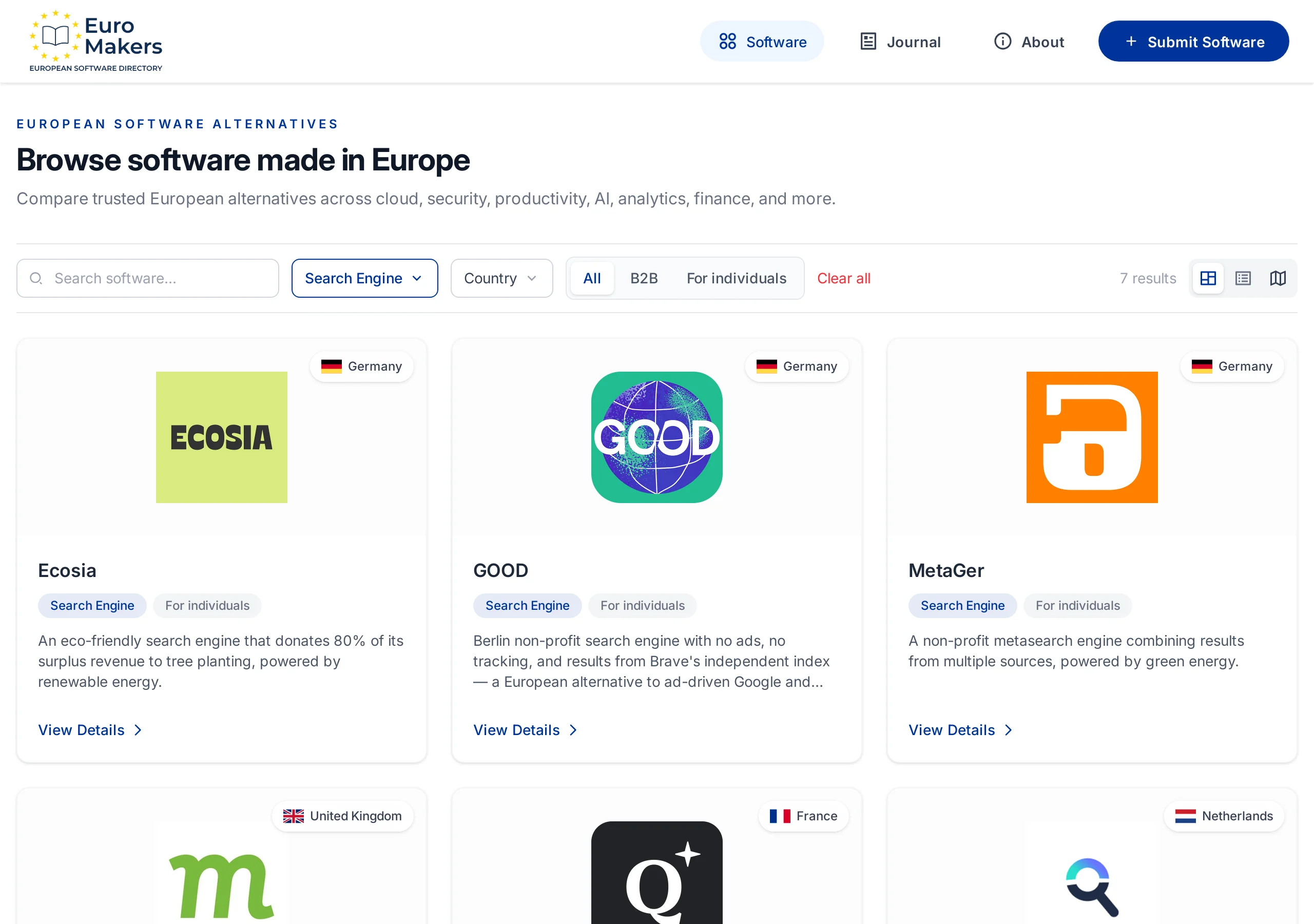
The Search Engines category currently lists seven tools. Here is the practical difference between them.
Familiar results, without the profiling
Startpage is the easiest place to begin if your main complaint is tracking, not result quality. It gives you Google results through a privacy layer, with no IP logging, no saved search history, and an anonymous-view option for opening result pages more privately. If you often end up going back to Google because other engines miss too much, Startpage is probably the least disruptive trial.
A European daily driver
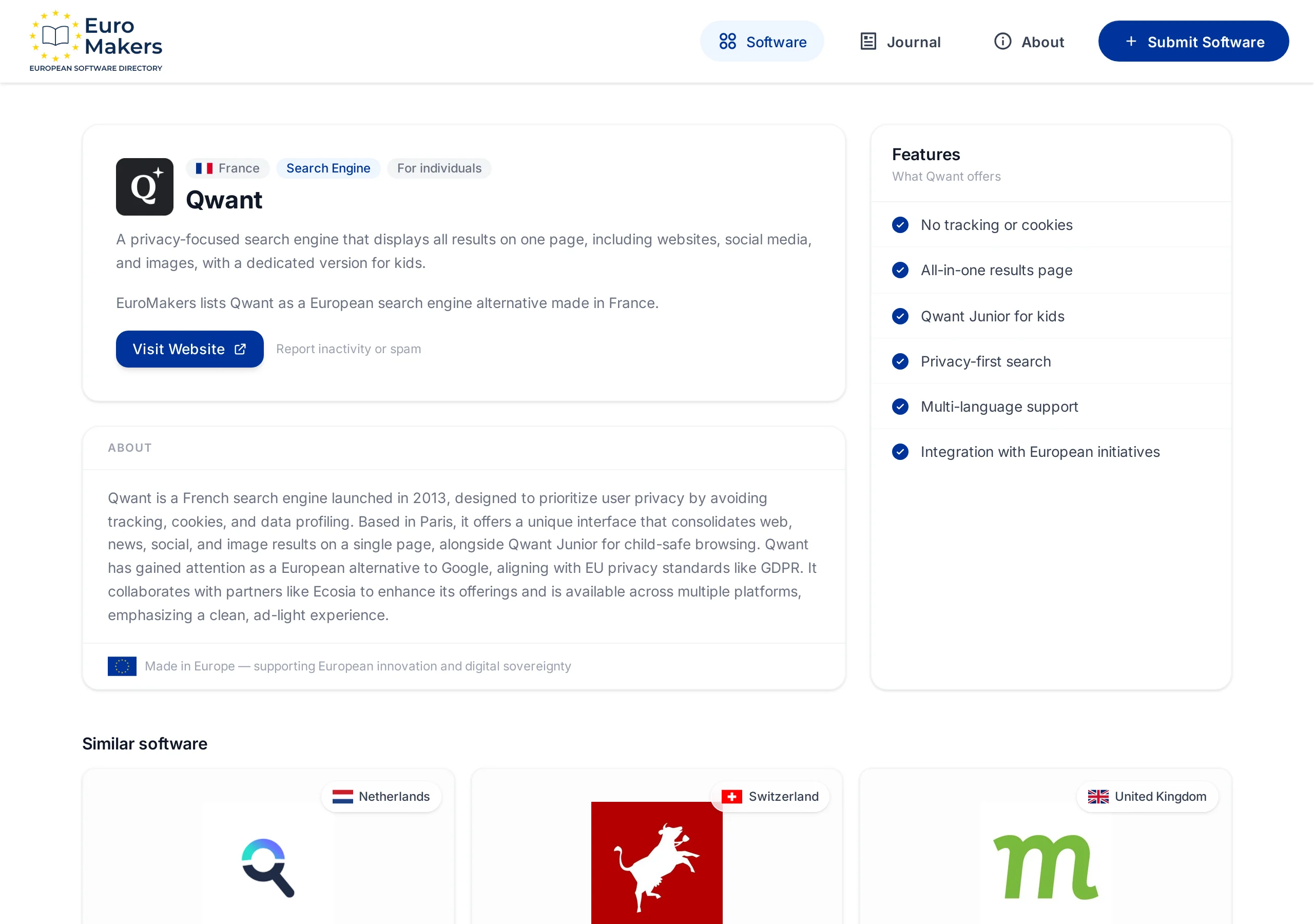
Qwant is the French search engine many Europeans already know. It has been around since 2013 and feels more like a full everyday product than a privacy experiment: web results, news, images, and a dedicated Qwant Junior version for children. Try Qwant when you want a European default that you could plausibly leave on for the whole household or team.
Search that funds something beyond the bill
Ecosia and GOOD both come from Germany, but they make very different promises about money.
Ecosia is the better-known option: ad-supported search that uses Bing infrastructure, adds its own layer, runs on renewable energy, and puts 80% of surplus revenue into tree planting. GOOD takes another route. It is ad-free, does not track users, uses Brave's independent index, and is owned by the Good Impact Foundation in Berlin. Choose Ecosia if you want a familiar, impact-led search engine. Choose GOOD if the ad model itself is what you want to avoid.
Own crawler or nonprofit metasearch
If the source of the index matters most to you, look at Mojeek and MetaGer.
Mojeek, based in the UK, crawls the web with its own index. That is rare, and it is the reason people who care about search independence pay attention to it. The trade-off is that some searches may feel thinner than Google, especially for very recent, local, or highly technical queries. MetaGer is a German non-profit metasearch engine with roots in the 1990s. It combines results from several sources, avoids profiling, and runs on green energy. Mojeek is the cleaner independent-index bet. MetaGer is the more pragmatic non-profit aggregation bet.
Family-safe search on a shared machine
Swisscows is the one to consider for a shared computer, school setup, or child's profile. It is hosted in Switzerland, avoids tracking, and keeps family-friendly filtering on by default. That is exactly what some households want. It is also the reason researchers may find it too restrictive. Treat it as a safer default, not as a universal replacement for every search use case.
A simple shortlist
- You want Google-like results with more privacy → start with Startpage.
- You want a broad European daily default → try Qwant.
- You want everyday searches to fund tree planting → use Ecosia.
- You want no ads and foundation ownership → look at GOOD.
- You care most about independent search infrastructure → test Mojeek and MetaGer.
- You need a safer shared-machine default → try Swisscows.
If you are unsure, do not test all seven. Pick Startpage and Qwant first. They answer the most common question: can I stop using Google as my default without making search annoying?
Try it like a normal person would
Search is easy to overthink because every engine has a philosophy. The real test is much simpler: use it for normal work.
- Pick two engines, not all seven.
- Set one as your browser default (or use its extension, if it has one).
- Use it for three to five days with your real searches: names, error messages, travel plans, local businesses, products, documentation, and whatever else you actually look up.
- When you open Google out of habit, write down what you were searching for.
That last note matters. If you only miss Google for maps, shopping, or very local searches, you may still be able to keep a European engine as your daily default and use Google deliberately for the few cases where it is clearly better.
Where European search feels different
The best European search products do not feel different because they shout about privacy. They feel different because the business model and governance are closer to the surface. Qwant avoids profiling. MetaGer is run by a non-profit. GOOD is foundation-owned. Ecosia publishes its environmental mission in a way users can follow. These are not tiny settings hidden in an account menu; they are part of the product.
That does not mean a European engine wins every query. Google is still very strong for recent, local, commercial, and technical searches. But a search engine does not have to beat Google everywhere to earn a place as your default. It has to be good enough for most days, clear enough about what it does with your data, and trustworthy enough that you are comfortable sending it hundreds of tiny questions a month.
The best search engine is the one you keep using after the novelty wears off.
— EuroMakers Editorial
Start here
Open the Search Engines category, read the listings that match your reason for switching, and pick two for a short trial. If you are still replacing your stack one tool at a time, start with how the Journal works or read our web analytics guide. Missing a European search engine we should list? Tell us.
Find your next European tool
Browse a curated directory of software made in Europe across every category your team relies on.
Explore the directory