How to Pick European Developer Tools for the Layer You're Building
Developer tools is not one product category. Here is how to choose among JetBrains, Buddy, Mockoon, n8n, Qdrant, Haystack, Medusa, and Lago by the layer of the stack you are actually touching.
The EuroMakers Editorial Team
Researching European software

The Journal · Made in Europe
A billing API is not an IDE. A vector database is not a CI pipeline. Yet they all sit in the same Developer Tools category — and that is where most comparisons go wrong. People try to crown a winner across the whole stack instead of naming the one layer that is slowing the product down this month.
Europe builds serious tools at almost every altitude of a modern product: editors in Prague, pipelines in Warsaw, mocks in Luxembourg, automation in Berlin, vectors and LLM frameworks in Germany, commerce in Copenhagen, billing in Paris. In EuroMakers, the useful move is not "switch everything." It is pick the layer you are building, then pick the European tool that owns that job.
What is actually stuck?
Skip the mega-roundup. Write the sentence that matches the friction already on your calendar.
- Our editors feel slow, shallow, or scattered across languages — we need a serious daily IDE.
- Deploys are brittle theater. We need CI/CD with preview environments we can trust.
- Frontend is waiting on backends that do not exist yet — we need fast API mocks.
- Too many handoffs live in spreadsheets and Slack. We need automation we can self-host or own.
- We are shipping AI features and need vectors or retrieval pipelines, not another chat demo.
- Commerce or billing is duct-taped. We need developer-first commerce or subscription infrastructure.
That sentence is the shortlist. Everything else can wait for the next quarter.
Eight European tools, eight layers
Here is a practical cut of the catalog — one strong European option per common build layer.
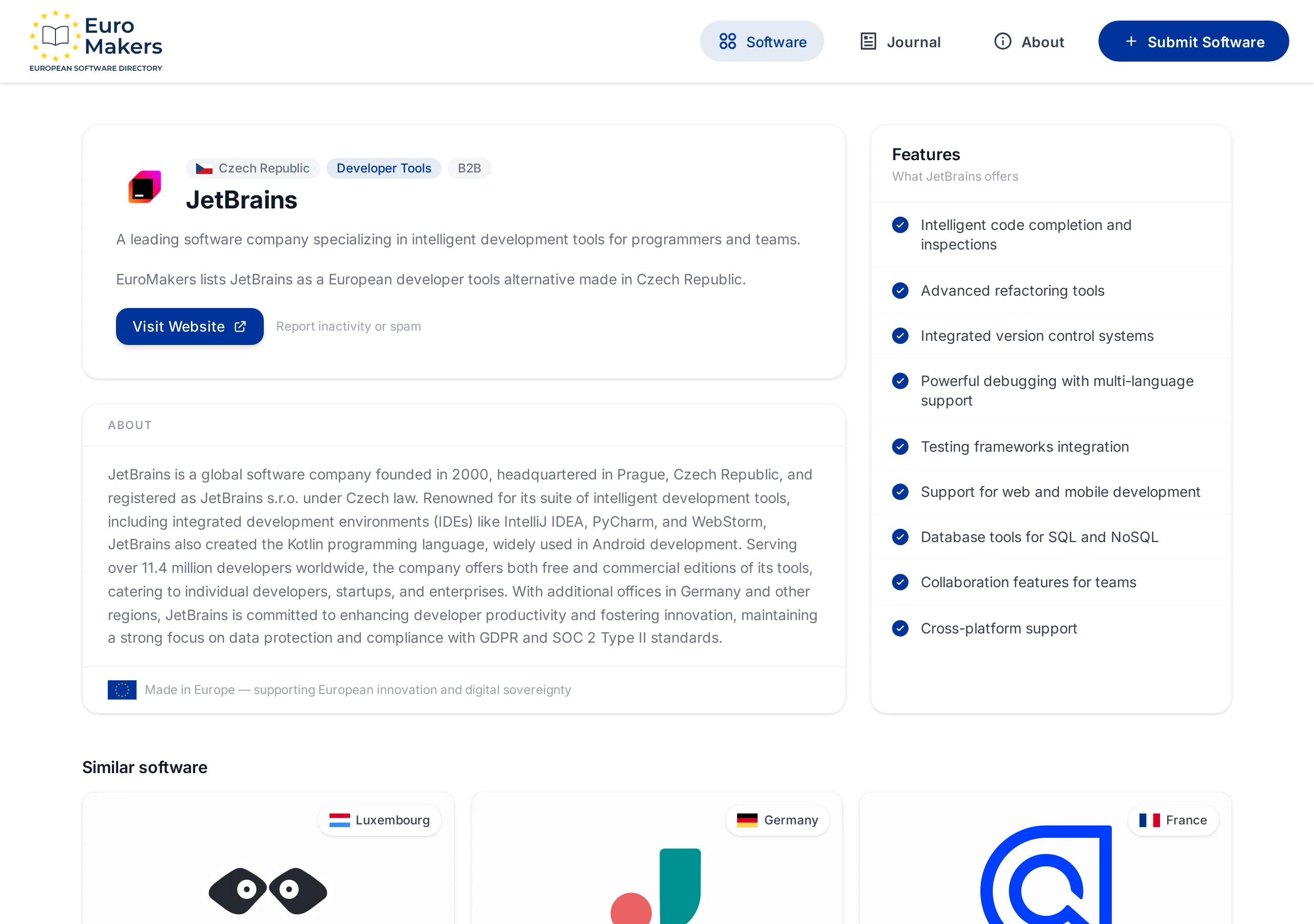
JetBrains — the Prague IDE workshop
JetBrains, founded in Prague, is the European answer when the layer is where you write code all day. IntelliJ IDEA, PyCharm, WebStorm, and the wider suite are built for deep inspections, refactoring, debugging, and multi-language teams — not for looking busy in a thin editor.
Choose JetBrains when editor craft is the bottleneck: navigation, inspections, and day-long focus. It is premium European tooling for people who treat the IDE as infrastructure, not as a free default.
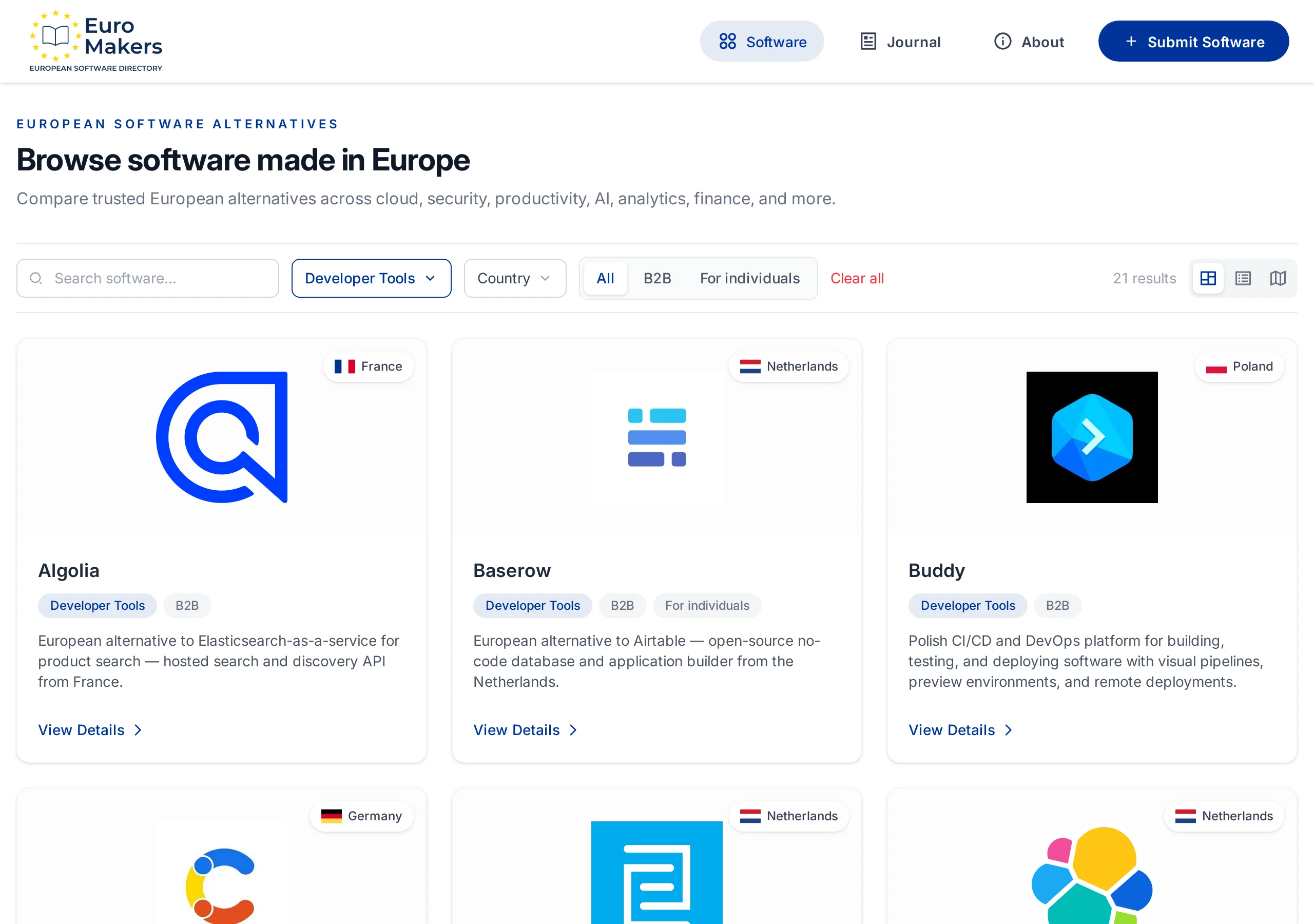
Buddy — Polish CI/CD with previews you can show
Buddy is built and operated in Warsaw. Visual pipelines (with YAML export), deploys to cloud, VPS, and bare metal, plus preview environments per branch or pull request — the product is aimed at teams that want delivery to feel approachable without becoming a weekend of YAML archaeology.
Choose Buddy when the stuck layer is shipping: flaky pipelines, missing previews, or deploys that only one person understands. It is a European CI/CD bet for teams that want craft in the delivery path — not another opaque pipeline nobody wants to touch.
Mockoon — Luxembourg mocks that unblock the week
Mockoon helps developers and QA simulate REST APIs locally or in the cloud — desktop app, CLI, templating, and shared environments — so frontend and tests do not wait on unfinished backends.
Choose Mockoon when the friction is dependency waiting. It is a small, sharp European tool: less ceremony than a full staging drama, more realism than hand-written fixtures you forget to update.
n8n — Berlin automation you can own
n8n is the Berlin-built fair-code workflow platform — visual node editor, hundreds of integrations, code nodes when you need them, and a self-host option when sensitive data should not leave your environment.
Choose n8n when the layer is glue: ops handoffs, CRM syncs, internal alerts, and the scripts that used to live in someone's head. It is the European option when no-code automation needs more ownership and room for real code.
Qdrant — German vectors for real similarity search
Qdrant is a Berlin-built vector database for similarity search on embeddings — payload filtering, quantization, Kubernetes-native scale, and cloud or on-premises deployment. Written in Rust, aimed at production AI features rather than notebook demos.
Choose Qdrant when the stuck layer is memory for AI: semantic search, recommendations, retrieval that has to stay fast under load. Pair it with the rest of your stack instead of hoping a single LLM call will invent memory for you.
Haystack — German pipelines for production LLM apps
Haystack, from deepset in Germany, is a modular framework for retrieval-augmented generation, document search, and custom LLM pipelines. It connects models, vector stores, and retrieval methods without locking you into one vendor's chat UI.
Choose Haystack when you are past the demo and need a pipeline you can compose, test, and ship. It is the European build kit for teams that treat AI as product infrastructure — not as a slide.
Medusa — Copenhagen commerce for builders
Medusa is a Danish headless commerce platform with TypeScript tooling, customizable APIs, multi-channel selling, and an extensible plugin system. It is built for developers who want storefront and admin control without a monolithic black box.
Choose Medusa when the commerce layer needs to be shaped — not rented as a rigid template. It sits well next to European payments, search, and hosting choices when you want the shop to feel like your product.
Lago — Paris billing for SaaS that grows up
Lago is a French billing API for subscription and usage-based SaaS — real-time metering, invoicing, payment gateway hooks, multi-currency, and workflows you can actually customize.
Choose Lago when billing logic has outgrown spreadsheets and a single Stripe price list. Metering and invoices are product surfaces; Europe has a billing API built for teams that treat them that way.
A shortlist by the layer you are in
- Daily IDE craft across languages → start with JetBrains.
- CI/CD with visual pipelines and preview environments → try Buddy.
- API mocks so frontend and QA stop waiting → open Mockoon.
- Self-hostable workflow automation with code when needed → look at n8n.
- Vector similarity search for AI features → evaluate Qdrant.
- Composable LLM / RAG pipelines → trial Haystack.
- Headless commerce you can customize in TypeScript → consider Medusa.
- Subscription and usage billing as an API → start with Lago.
Prague shapes the editor. Warsaw ships the pipeline. Luxembourg unblocks the mock. Berlin automates the glue and stores the vectors. Germany composes the LLM path. Copenhagen builds the shop. Paris meters the bill. That spread is the continental advantage — specialized craft across countries, not one distant vendor pretending to own every layer.
Change one layer for one honest sprint
Developer tools fail in the middle of a release, not in a feature matrix. Keep the first trial small enough to reverse.
- Pick one stuck layer and one European candidate from the shortlist above.
- Run it beside the current tool for a single sprint — do not migrate the whole company on day one.
- Measure the boring truth: time to first useful output, failure modes, docs quality, and how loud the on-call feels.
- Write down what would break if you kept it — licenses, self-host ops, team habits, vendor integrations.
- Only then expand: a second project, a second team, or the next layer of the stack.
Made in Europe, felt in the craft
Made in Europe earns its place here as a premium quality label — not a checklist of headquarters. You feel it in finished developer experience, restrained defaults, clear contracts between layers, and tools built by people who still care how a workday feels when something breaks at 16:40.
Unity shows up as range. An IDE suite, a CI platform, a mocking tool, an automation engine, a vector database, an LLM framework, a commerce kit, and a billing API can share one catalog without collapsing into one brand. That is continental craft: different countries, different strengths, one serious alternative to renting the whole stack from elsewhere.
Pick the layer that is stuck — then pick the European tool that owns that job.
— EuroMakers Editorial
Start here
Open the Developer Tools category, read the listings that match your stuck layer, and give one candidate a single honest sprint. If infrastructure or delivery is next, keep going with our guide to European cloud hosting — or the editorial on the European swap that sticks. Missing a European developer tool we should list? Tell us.
Find your next European tool
Browse a curated directory of software made in Europe across every category your team relies on.
Explore the directory
