The European Swap That Actually Sticks
Replacing your whole stack overnight rarely works. The European tools people keep are the ones that earn a place in an ordinary week — one category at a time.
The EuroMakers Editorial Team
Researching European software

The Journal · Made in Europe
Every few months someone announces they are "going European" with their software. New email. New analytics. New vault. New everything. Two weeks later, half the tabs are back on the old defaults — not because Europe lacks good tools, but because a full-stack migration is a project, and projects lose to Tuesday.
The swaps that stick look quieter. Someone opens the EuroMakers directory, picks one category that is already annoying them, and gives a European option a real job for a week. No manifesto. Just a better habit that survives an ordinary workday.
Why big migrations bounce
A stack rewrite asks you to relearn five interfaces while still shipping the same work. Muscle memory fights you. Colleagues keep inviting you in the old calendar. Autofill still points at the old vault. The new tools never get a fair trial because they arrive as a pile.
Europe does not need a loyalty oath. It needs you to keep one excellent product long enough that the rest of the shortlist becomes curiosity, not homework.
What makes a European swap stick
After writing category guides across analytics, search, cloud, email, calendars, and password managers, the pattern is almost boring — and that is why it works.
- The pain is already real. You are paying too much, fighting a cookie banner, or sharing passwords in chat. Motivation beats ideology.
- The job is daily. Tools you open every morning earn loyalty faster than tools you admire in a feature matrix.
- The trial is concrete. One real task for seven days beats a weekend of settings screenshots.
- The exit is cheap. If it fails, you still learned what "good" means for that category.
"Made in Europe" helps here as a premium quality label — craft, restraint, and products shaped by European makers across the continent — not as a guilt filter. You are choosing something built to last, not collecting flags.
Three swaps that tend to stick
Not every category is a good first move. These three usually are — because they sit in the daily path and Europe already has mature options.
Analytics you can explain in one sentence
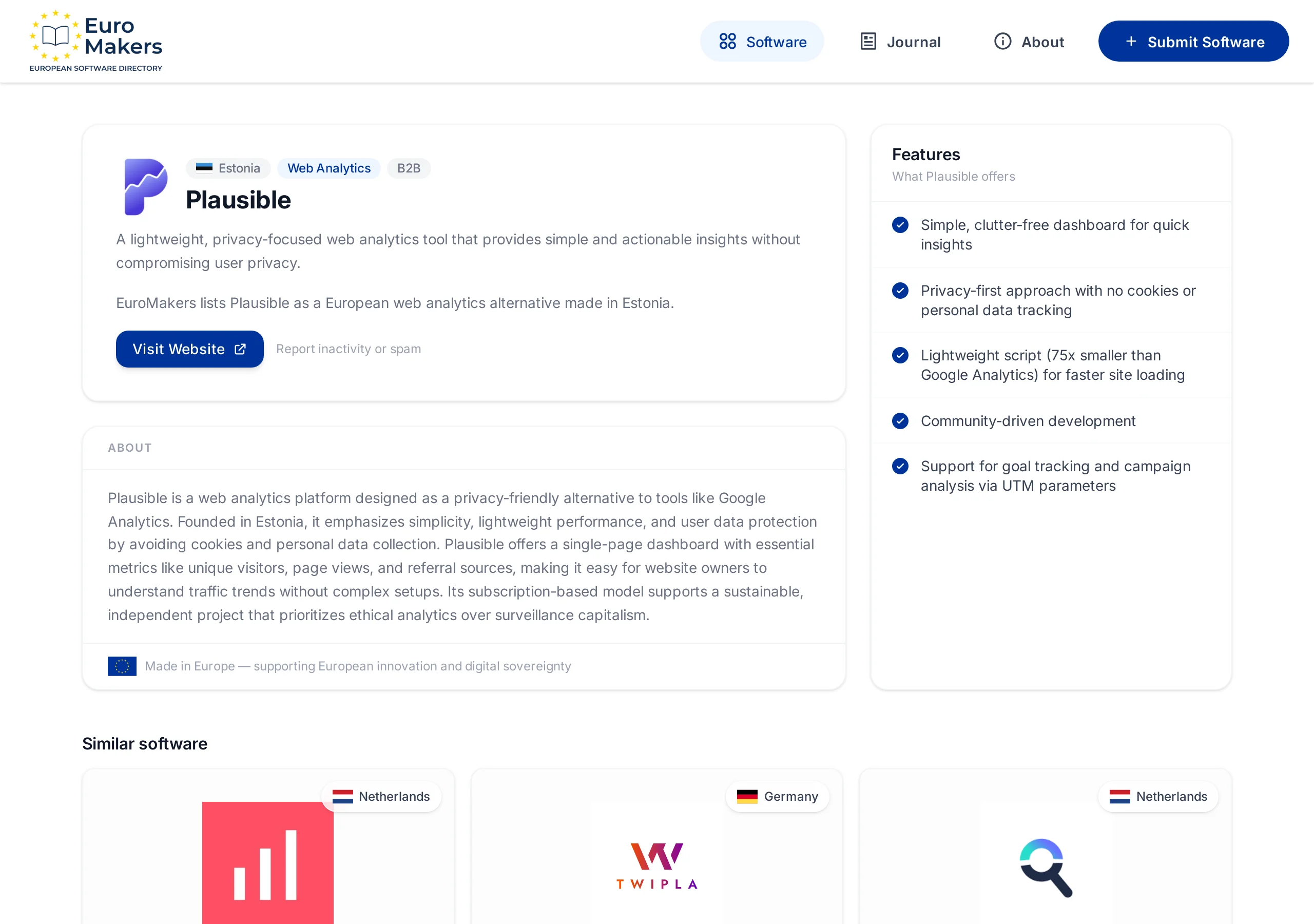
Plausible, Simple Analytics, and TWIPLA are the kind of swap teams keep: lighter dashboards, numbers you can explain in one sentence, and less ceremony around measurement. Our web analytics guide walks the shortlist. The sticky version is simpler — pick one site, keep the old tool in parallel for a week, and see which report you actually open.
Search that becomes the default tab
Search only sticks if you stop noticing it. Qwant, Startpage, Ecosia, and the rest of the search category compete on whether the results feel good enough that you never flip back. Set one browser profile to a European engine for three days. If you keep reaching for the old tab, you learned something useful. If you forget you switched, that is the win. Details live in the search engine guide.
A vault you trust on Monday morning
Password managers stick when recovery and sharing match how you actually work. Passbolt for teams, Proton Pass inside a broader suite, KeePassXC for a local database — different jobs, same rule: migrate the ten logins you use daily first, not the whole archive. See the password manager guide when you are ready to choose the vault shape.
The swaps that usually bounce
Be honest about hard first moves. Replacing company-wide email, calendar, and chat in the same fortnight asks every colleague to change habits at once. Cloud cutovers that touch production without a clear workload map create fear, not loyalty. Niche tools you open twice a month never get enough reps to feel native.
Those categories still matter — we cover email and calendar and cloud hosting for a reason. They are simply better as second or third swaps, after one daily tool has already proven that Made in Europe can feel premium in your hands.
The goal is not a European stack poster. The goal is one tool you would miss if it disappeared.
How to choose your one
- Name the annoyance in one sentence — cost, friction, trust, or missing features.
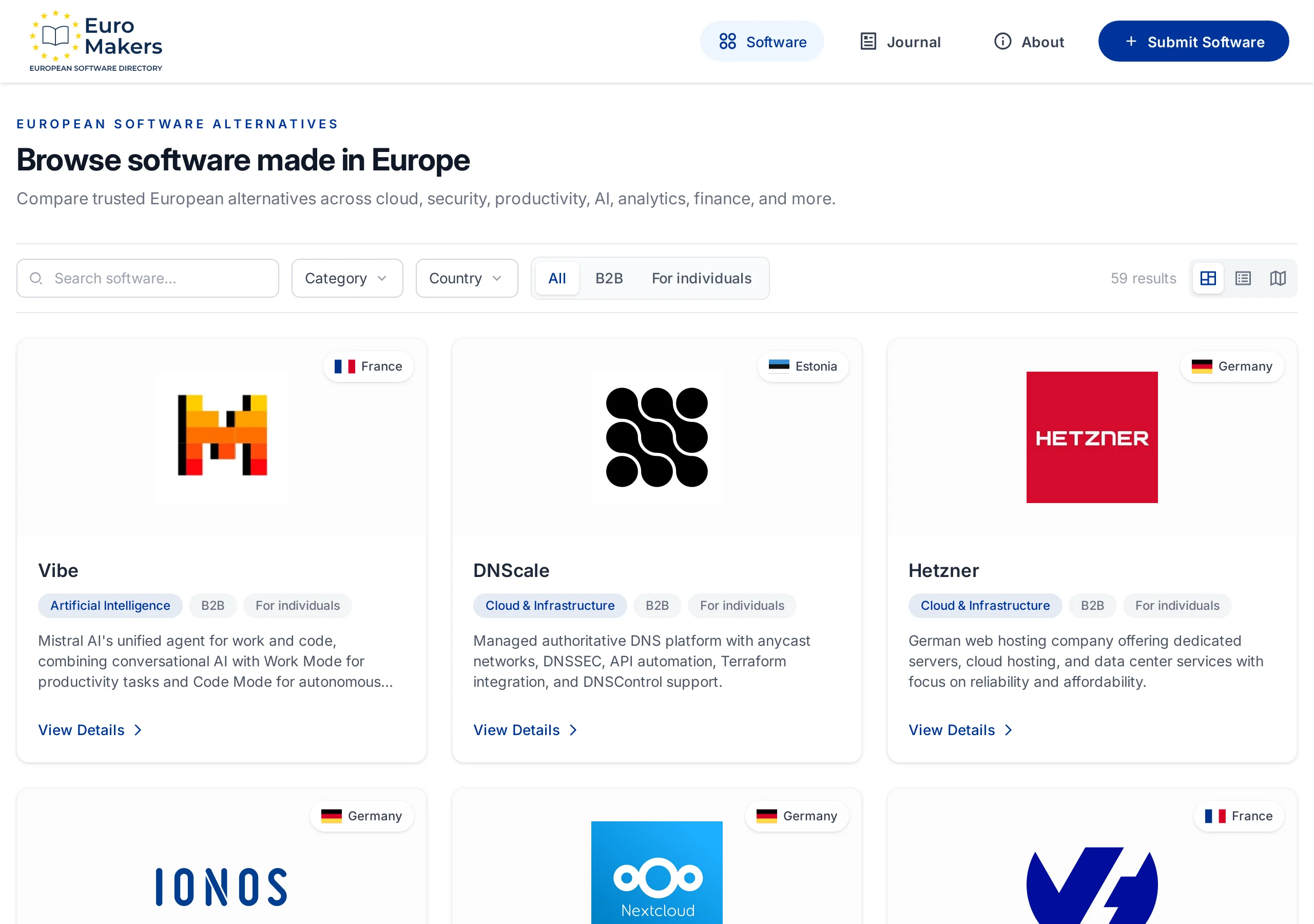
- Open the software directory and filter to that category only.
- Shortlist two European listings, not seven.
- Run the same real task in both for a week. Keep score on annoyance, not vibes.
- Keep the winner. Leave the rest of your stack alone until this one feels boringly reliable.
If neither sticks, you have not failed Europe. You have refined the brief. Come back with a sharper constraint — or tell us which category still feels thin. The Journal sits in the messy middle between "what exists" and "what I will still use in October."
Start with one. Make it excellent. Let the continent earn the next seat at the table.
Find your next European tool
Browse a curated directory of software made in Europe across every category your team relies on.
Explore the directory